
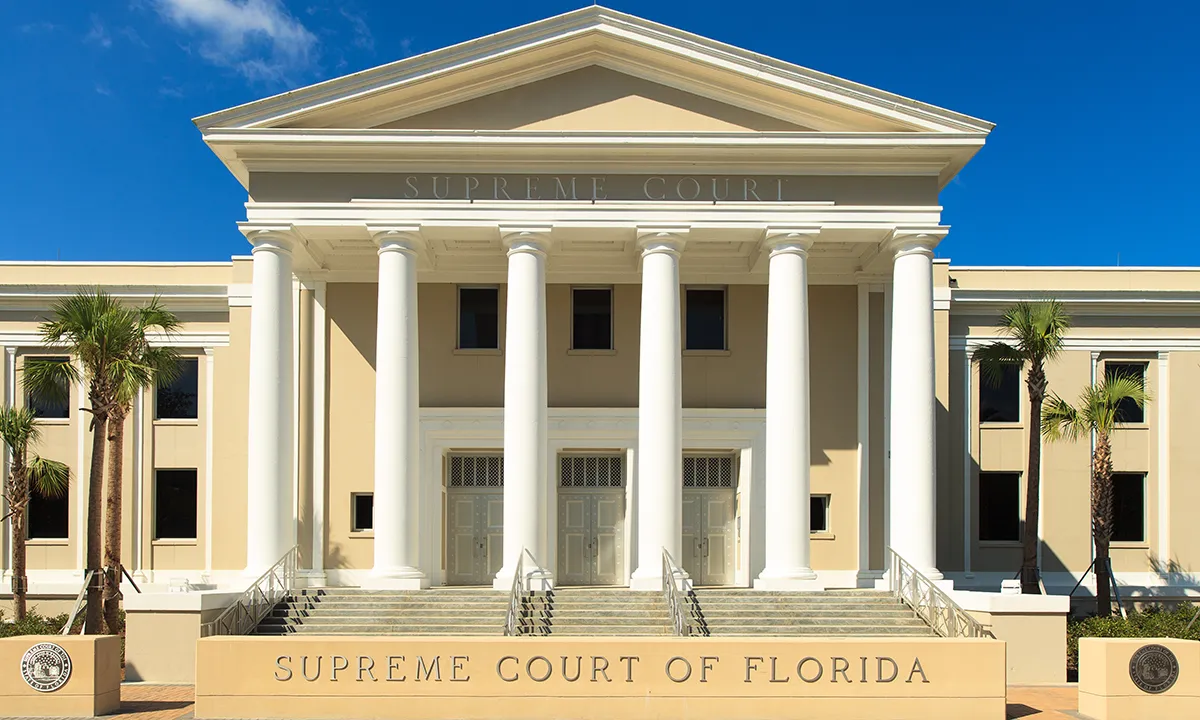
The Florida Supreme Court Just Made It Easier to Go After a Defendant's Conduct, Not Just Their Bumper
On June 11, 2026, the Florida Supreme Court lowered the bar an injured person has to clear before pleading punitive damages. Here's what that ruling actually changes for Florida accident victims, and what it does not.

Quick Summary
On June 11, 2026, the Florida Supreme Court decided Perlmutter v. Federal Insurance Company and lowered the bar an injured person has to clear before pleading punitive damages. Trial judges now look only at the claimant's evidence at that stage, and the clear and convincing standard applies at trial rather than at the pleading gate. For Florida accident victims, this changes what happens when the other side's conduct was genuinely reckless.
→ Complete Florida Accident Guide
Key Takeaways
- The Florida Supreme Court decided Perlmutter v. Federal Insurance Company on June 11, 2026, resolving a conflict among Florida's appellate districts. SOURCE: Perlmutter v. Federal Ins. Co., No. SC2024-0058 (Fla. June 11, 2026)
- The clear and convincing evidence standard now applies at trial, not at the pleading stage. SOURCE: Perlmutter, No. SC2024-0058
- At the pleading stage a trial court considers only the claimant's evidence, not the defendant's rebuttal evidence. SOURCE: Perlmutter, No. SC2024-0058- Video
- The test is whether a reasonable person could conclude the defendant committed intentional misconduct or gross negligence, as those terms are defined by statute. SOURCE: Fla. Stat. § 768.72(2)
- Discovery into a defendant's financial worth is blocked until punitive damages are permitted, which makes the pleading decision the real chokepoint. SOURCE: Fla. Stat. § 768.72(1)
- Punitive damages are generally not covered by liability insurance, which is exactly why defendants fight so hard at this stage.
- This ruling doesn't change ordinary negligence claims. It matters in the subset of cases where conduct crosses well past carelessness.
What This Means for You
Most injury cases are about compensation. What did this cost you in medical bills, lost income, and the life you can no longer live the same way? That's compensatory damages, and it's the bulk of what I do.
Punitive damages are different. They aren't about your losses. They're about punishing conduct that was so far past ordinary carelessness that the law wants to deter it.
Florida makes you ask permission before you can even plead them. You have to make a showing to the judge first, and until the judge says yes, you can't look into what the defendant is actually worth. That permission step is where these claims live or die.
What the Florida Supreme Court did in June was make that gate easier to get through. Not automatic. Easier.
I've handled Florida injury claims for 16 years and recovered more than $100 million for clients, and I'll be direct with you about what this ruling does and doesn't mean for an ordinary car accident. Most of the time, nothing. In the cases where a drunk driver hit you, or a trucking company knowingly put an unqualified driver on the road, or a property owner ignored a hazard they'd been warned about repeatedly, it can matter enormously.
What the Court Actually Decided
The Question Before the Court
Florida Statute § 768.72(1) says no claim for punitive damages is permitted unless there's a reasonable showing by evidence in the record, or proffered by the claimant, that would provide a reasonable basis for recovery. SOURCE: Fla. Stat. § 768.72(1)
Florida's appellate districts had split on what that means in practice. One district had required the trial court to weigh all the evidence from both sides and decide whether a reasonable jury could find punitive damages warranted by clear and convincing evidence. Other districts applied a lighter test.
The Holding
The Florida Supreme Court answered the certified question no. The Court held that the clear and convincing evidence standard governs at trial, and does not apply when the trial court evaluates the sufficiency of the claimant's evidentiary showing at the pleading stage. SOURCE: Perlmutter v. Federal Ins. Co., No. SC2024-0058 (Fla. June 11, 2026
The Court also held that at that stage, the trial court looks only at the evidence the claimant put forward, not at contrary evidence the defendant submits in opposition.
The test the Court described is whether a reasonable person could conclude, based on the claimant's evidence, that the defendant committed intentional misconduct or gross negligence as those terms are defined in section 768.72(2).
What the Court Did Not Do
This is important, and I want to be precise about it. The Court did not change what punitive damages require at trial. Clear and convincing evidence is still the standard a jury applies. The statutory definitions of intentional misconduct and gross negligence are unchanged. The statutory limits on punitive damage amounts are unchanged.
The Legislature didn't amend anything. A court interpreted an existing statute.
Why the Pleading Stage Was Always the Real Fight
The Financial Discovery Lock
Section 768.72(1) provides that no discovery of financial worth proceeds until the punitive damages pleading is permitted. SOURCE: Fla. Stat. § 768.72(1)
That single sentence is why defendants pour resources into the pleading stage. As long as the punitive claim stays out, the defendant's assets, revenue, and financial condition stay completely off limits. The moment it comes in, that door opens.
Insurance Usually Doesn't Cover Punitive Damages
Compensatory damages generally get paid by an insurance policy. Punitive damages generally don't. That means a punitive claim points at the defendant personally or at the company's own balance sheet rather than at a carrier.
Defense firms writing about this ruling have said openly that it may create more pressure from insurers on their own insureds to settle earlier, in order to avoid the cost and exposure of a prolonged fight.
What This Means for Settlement Timing
A case where a punitive claim is realistically available behaves differently than one where it isn't. It gets evaluated differently, it gets defended differently, and it often resolves differently.
That's the practical effect of this ruling for injured Floridians. Not a new category of damages. A shifted balance of pressure in the cases that already warranted it.
What Kinds of Florida Injury Cases Might Actually Involve Punitive Damages
I want to set expectations honestly here, because the phrase "punitive damages" gets thrown around far too casually.
Drunk and Impaired Driving
A driver who chose to drive impaired and injured someone is the clearest and most common example in Florida injury practice.
Commercial Trucking Violations
Cases where a carrier knew about hours-of-service violations, ignored maintenance defects, or kept a driver on the road after documented safety failures.
→ Truck Accidents in Florida: Why Commercial Vehicle Claims Are Different From Regular Car Accidents
Fleeing the Scene
Leaving an injured person on the road is conduct a jury understands immediately, and it's frequently accompanied by evidence of consciousness of wrongdoing.
→ What to Do After a Hit-and-Run Accident in Florida (Even If the Driver Is Never Found
Ignored and Documented Hazards
A property owner who received repeated complaints or prior incident reports about a dangerous condition and did nothing.
Extreme Speed or Racing
Conduct that goes past inattention into a conscious disregard for the safety of everyone nearby.
Ordinary carelessness does not qualify. Looking at a phone for a moment, misjudging a gap, following too closely. Those are negligence, they're compensable, and they're most of what happens on Florida roads. Punitive damages are for the cases where something worse was going on.
A Case Where the Conduct Was the Whole Case
I represented a family after a crash on a Broward County roadway where the at-fault driver had a blood alcohol level well over the legal limit at nine in the morning. My clients' compensatory damages were significant on their own. Medical care, lost income, a permanent impairment.
But when we started developing the file, what came out mattered more than the crash itself. This wasn't a first offense, and it wasn't close to one. There was a documented history, and there had been an employer who knew the driver was operating a company vehicle after prior incidents.
The compensatory case was about what my clients lost. The conduct case was about why it kept happening. Those are two different conversations, and once the second one was on the table, the entire posture of the defense changed.
I'm not going to tell you every case has that second conversation available. Most don't. But when the facts support it, getting there earlier now than you could have a year ago is a real change.
If you were injured by a driver or a company whose conduct went beyond ordinary carelessness, call my office today for a free consultation. There's no fee unless I win your case. Contact Kris
What to Do If You Think the Other Side's Conduct Was Reckless
- Write down everything you observed about the other person's behavior. Slurred speech, the smell of alcohol, admissions made at the scene, how fast they were going, whether they tried to leave.
- Preserve the scene evidence immediately. Photograph the vehicles, the roadway, any open containers visible, and the surrounding area.
- Make sure a police report exists and note whether any criminal charges were filed. A parallel criminal case generates records that support the civil claim.
- Identify witnesses who saw the conduct, not just the impact. Someone who watched the other driver weaving for a mile is a different kind of witness than someone who heard the crash.
- Note whether a commercial vehicle or an employer was involved. Employer knowledge is often what elevates a case, and those records must be preserved in writing quickly.
- Do not discuss the other party's conduct publicly or on social media. Insurers monitor claimants' accounts, and speculation posted online gets used against you.
→ Why Insurance Companies Are Stalking Your Social Media (And How to Protect Yourself
- Get medical treatment within 14 days and keep it consistent. No amount of bad conduct by the other side compensates for a gap in your own treatment record.
- Talk to a Florida injury attorney early. Whether a punitive claim is realistic is a judgment call that depends on evidence that has to be gathered before it disappears.
⚠️ Critical Warning: Punitive damages in Florida require court permission before they can be pleaded, and financial discovery is blocked until that permission is granted. The evidence supporting that request has to be developed early, not raised for the first time on the eve of trial.
Frequently Asked Questions
What are punitive damages in Florida?Punitive damages are awarded to punish and deter conduct amounting to intentional misconduct or gross negligence, rather than to compensate the injured person for their losses. SOURCE: Fla. Stat. § 768.72
What did the Florida Supreme Court decide in Perlmutter?The Court held that the clear and convincing evidence standard applies at trial and not at the pleading stage, and that a trial court evaluating a motion to plead punitive damages considers only the claimant's evidence. SOURCE: Perlmutter v. Federal Ins. Co., No. SC2024-0058 (Fla. June 11, 2026)
Does this ruling apply to my car accident case?Only if the facts involve conduct that goes well beyond ordinary carelessness. The ruling changed a procedural standard. It didn't create a new right to punitive damages in routine negligence cases.
Can I get punitive damages just because I was badly injured?No. The severity of your injuries drives compensatory damages. Punitive damages depend entirely on the nature of the defendant's conduct.
Are punitive damages covered by insurance?Generally not. That's a significant reason defendants fight so hard to keep punitive claims out of a case.
Is there a cap on punitive damages in Florida?Florida statutes limit punitive damage awards, with the general limit set in relation to the compensatory damages awarded and specific exceptions defined by statute. SOURCE: Fla. Stat. § 768.73
Do I have to ask a judge before claiming punitive damages?Yes. Florida requires a reasonable evidentiary showing and the court's permission before a punitive damages claim can be pleaded. SOURCE: Fla. Stat. § 768.72(1)
Does a punitive claim make my case take longer?Not necessarily. Defense commentary on this ruling has suggested it may increase pressure to resolve some cases earlier rather than face extended litigation and financial worth discovery.
Does this change the two-year filing deadline?No. Most Florida negligence claims must still be filed within two years of the date of injury. The ruling addressed a pleading standard, not a limitations period.
What if the at-fault driver was working at the time?Employer involvement can change a case substantially, particularly where the employer knew or should have known about a risk. Those records need to be preserved early.
Final Thoughts
Rulings like this one usually get written up for defense lawyers and insurance executives and never reach the people they actually affect. That's what bothered me about the coverage of Perlmutter. Every serious analysis I read was addressed to claims departments.
So here's the version for the person who was actually hurt. Florida law has always said that some conduct deserves more than a bill for the damage it caused. Getting to that question required clearing a gate, and in some parts of the state that gate had been set higher than the statute required. The Supreme Court corrected it.
If your case is an ordinary crash caused by an ordinary mistake, none of this touches you, and your case is still worth what it's worth. If somebody made a choice that endangered everyone around them and you're the one who paid for it, the door to that conversation is measurably more open today than it was in May.
Get Help Now
If you were injured in Miami-Dade, Broward, or Palm Beach County and you believe the person or company responsible did something worse than make a mistake, I want to hear about it. Kris Torres Injury Law has offices in Miami and Jupiter, and I offer a free consultation with no obligation. I work on a contingency fee, so you pay nothing unless I recover money for you. Call now for a free case review.
Disclaimer
This article is provided for general informational purposes only and does not constitute legal advice. Reading this article does not create an attorney-client relationship with Kris Torres Injury Law. Discussion of court decisions is provided for general context and does not predict the outcome of any specific case. Every case is different and outcomes depend on the specific facts involved. If you have been injured, consult a licensed Florida attorney about your particular situation.