Driverless Cars Are on Miami Streets Now. They Carry 100 Times More Insurance Than the Driver Next to You.
ully driverless robotaxis now carry paying passengers in Miami. Florida law treats the automated driving system as the operator and requires $1 million in primary liability coverage, while an ordinary driver is required to carry $10,000 in PIP. Here's what that means if one hits you.

Quick Summary
Fully driverless robotaxis began carrying paying passengers in Miami in January 2026. Under Florida law, the automated driving system is treated as the operator, and those vehicles must carry at least $1 million in primary liability coverage. The human driver in the next lane is required to carry $10,000 in PIP and no bodily injury coverage at all. If you're hit in Miami-Dade, who hit you may matter more than it ever has.
→ Complete Florida Accident Guide
Key Takeaways
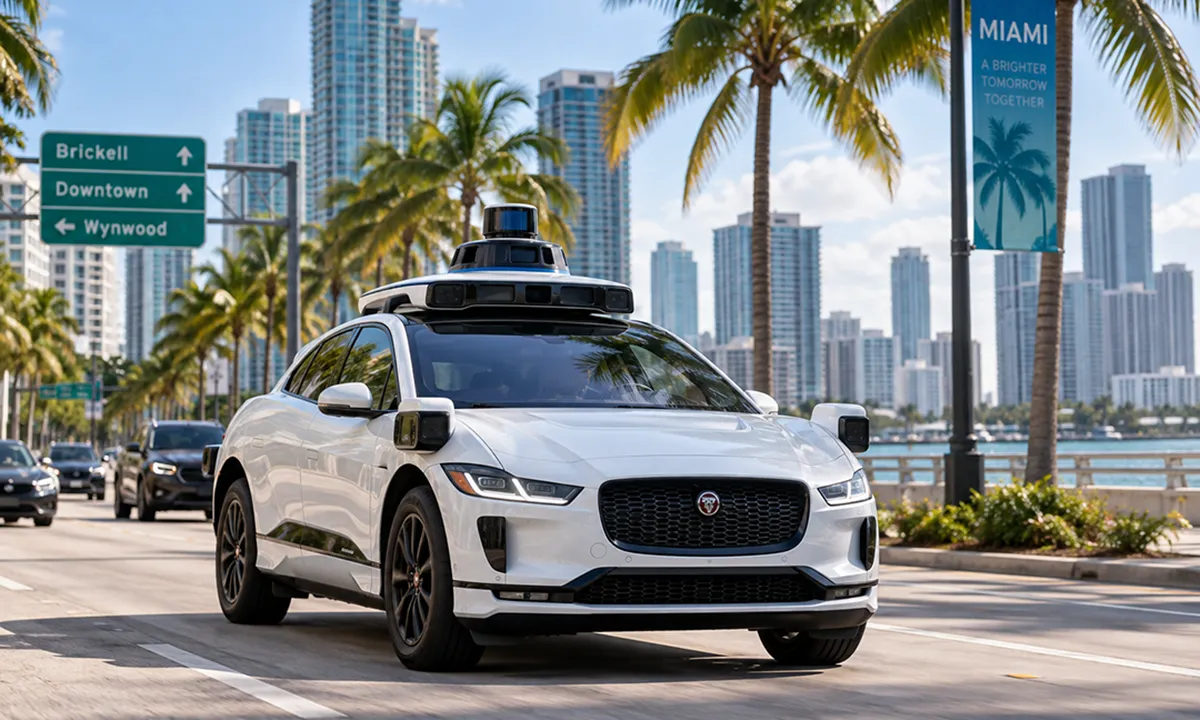
- Driverless robotaxis now operate commercially across roughly 60 square miles of Miami, covering Brickell, Wynwood, the Design District, and Coral Gables. SOURCE: Waymo's official Miami launch announcement
- Florida law treats the automated driving system as the vehicle's operator when it's engaged, whether or not a person is inside. SOURCE: Fla. Stat. § 316.85
- A fully autonomous vehicle on an on-demand network must carry at least $1 million in primary liability coverage for death, bodily injury, and property damage. SOURCE: Fla. Stat. § 627.749
- Florida requires ordinary drivers to carry $10,000 in PIP and $10,000 in property damage, with no bodily injury liability coverage required in most cases.
- Federal regulators have open investigations into autonomous vehicle behavior, including a preliminary evaluation into performance around stopped school buses. SOURCE: NHTSA ODI, PE25013
- Local governments in Florida can't impose their own rules on autonomous vehicles. The Legislature reserved that authority to the state.
- Evidence in these crashes is almost entirely digital, and it lives on servers owned by the company you'd be making a claim against.
What This Means for You
Most people's reaction to a driverless car is either fascination or unease. Mine is more practical. I look at who's insured and for how much.
Here's the part that surprises clients. If a robotaxi is at fault in a crash that injures you in Miami-Dade County, you're dealing with a vehicle that Florida law requires to carry $1 million in primary liability coverage. If the person who hit you was driving their own car, Florida law may require nothing at all beyond $10,000 in PIP and $10,000 in property damage.
That's a hundredfold difference in available coverage, decided by which vehicle happened to be in the intersection.
I'm not here to tell you autonomous vehicles are good or bad. I've spent 16 years handling injury claims in South Florida and recovered more than $100 million for clients, and what I care about is whether an injured person can actually recover. On that narrow question, the law around driverless vehicles is currently more protective than the law around human ones.
The harder problem is proving what happened.
What Florida Law Actually Says About Driverless Vehicles
The Software Is the Driver
Florida Statute § 316.85 says that when the automated driving system is engaged, that system is deemed the operator of the vehicle. A licensed human operator isn't required, and the vehicle may operate whether or not anyone is physically inside it. SOURCE: Fla. Stat. § 316.85
That's a bigger deal than it sounds. In a normal crash, the negligence question is about a person's choices. Did they look? Did they brake? Were they distracted? When the operator is software, the question becomes what the system detected, what it decided, and whether that decision was reasonable.
The Insurance Requirement Is Unusually Strong
Florida Statute § 627.749 requires that a fully autonomous vehicle operating on an on-demand network or engaged in a prearranged ride carry a policy providing primary liability coverage of at least $1 million for death, bodily injury, and property damage. It must also carry PIP benefits meeting Florida minimums and uninsured and underinsured motorist coverage. SOURCE: Fla. Stat. § 627.749
The coverage can be maintained by the vehicle owner or by the network itself. Either way, the floor is $1 million, not $10,000.
Cities and Counties Can't Add Their Own Rules
Florida law states the Legislature's intent to keep autonomous vehicle regulation uniform statewide and bars local governments from imposing their own taxes, fees, or requirements on autonomous vehicles. SOURCE: Fla. Stat. § 316.85
So Miami-Dade County can't set its own robotaxi safety standard, and neither can Coral Gables or Miami Beach. The rules come from Tallahassee and, on the safety defect side, from Washington.
What Federal Regulators Are Currently Looking At
The National Highway Traffic Safety Administration's Office of Defects Investigation opened a preliminary evaluation into how one company's automated driving system performs around stopped school buses, after documented incidents of a driverless vehicle proceeding past a bus with its red lights flashing and stop arm extended. SOURCE: NHTSA ODI, Preliminary Evaluation PE25013
A separate federal investigation followed a driverless vehicle striking a child near an elementary school. SOURCE: NHTSA ODI investigation records
I want to be careful here. An open investigation isn't a finding, and a recall doesn't establish fault in any individual crash. But these records matter for a different reason. They're public, they're government-generated, and they document what a manufacturer knew and when. That's the kind of evidence that's normally impossible to get in an ordinary car crash.
Why These Crashes Are Harder to Prove, Not Easier
The Evidence Belongs to the Defendant
In a typical crash, evidence is scattered. Skid marks, a police report, a witness, maybe a doorbell camera. In a robotaxi crash, nearly everything is generated by the vehicle itself. Sensor logs, camera footage from multiple angles, the system's own record of what it perceived and what it decided.
All of it sits on servers controlled by the company you'd be filing a claim against. It won't be handed over because you asked politely.
Preservation Has to Happen Immediately
Companies operating these fleets have data retention policies. Once a claim is anticipated, a written preservation demand has to go out fast, identifying the specific vehicle, the specific time window, and the categories of data involved.
Waiting three months to hire a lawyer in one of these cases is not the same as waiting three months in an ordinary rear-end case.
More Than One Party May Be Responsible
The network operator, the vehicle owner, the fleet management partner, a sensor or software supplier, and in some situations a remote human supervisor may all have played a role. Sorting that out early determines which policies are actually reachable.
A Case That Explains Why I Take Digital Evidence Seriously
Years before robotaxis reached Miami, I represented a man rear-ended on the Palmetto by a delivery van. The driver said my client had stopped short. My client said the van never slowed. Two stories, no witnesses, and a police report that took no position.
What decided it was telematics. The van was fleet-equipped, and the data showed no braking input until roughly one second before impact, at a following distance that was never adequate for the speed. The company's own system contradicted its own driver.
We got that data because we demanded it in writing within days. Fleet telematics on that system overwrote on a rolling cycle. Another few weeks and it would have been gone, and the case would have come down to which person the jury believed.
Every driverless vehicle on the road today is that case, multiplied. The data exists and it's decisive, and it is only useful to you if somebody moves quickly to lock it down.
If you were injured in a crash anywhere in Miami-Dade, Broward, or Palm Beach County, call my office today for a free consultation. There's no fee unless I win your case. Have a Question? Give me a call.
What to Do If You're Hit by a Driverless Vehicle in Florida
- Call 911 and make sure a police report is generated. Do this even if the vehicle has no driver to exchange information with. The report anchors the date, time, and location that any data request will be built around.
- Photograph the vehicle's identifying markings. Fleet number, license plate, company branding, and the sensor array. You need to be able to identify the specific vehicle later, not just the company.
- Photograph the full scene before anything moves. Vehicle positions, signals, lane markings, debris, and the surrounding businesses. Note which nearby buildings have cameras.
- Look for human witnesses right away. A driverless car has no driver's account to contradict. Bystanders may be the only independent version of events.
- Get medical attention the same day. Florida's 14-day rule still governs your PIP benefits, and a treatment gap is the first thing any insurer will use to discount your injuries.
- Do not accept a quick settlement offer from the company. Fleet operators are sophisticated and move fast. An early offer arrives before anyone knows what your injuries actually are.
- Do not give a recorded statement to any insurer or company representative before speaking to an attorney.
- Contact a Florida injury attorney immediately so a preservation demand can go out. This is the step that separates a provable case from a disputed one.
⚠️ Critical Warning: In a crash involving an autonomous vehicle, the most important evidence is created and stored by the company you would be making a claim against. Written preservation demands need to go out within days, not months.
Frequently Asked Questions
Are driverless cars legal in Florida?Yes. Florida law permits fully autonomous vehicles to operate without a human operator present, and treats the automated driving system as the operator when engaged. SOURCE: Fla. Stat. § 316.85
Who do I sue if a driverless car hits me?Depending on the facts, potentially the network operator, the vehicle owner, the fleet partner, or a component or software supplier. Identifying every responsible party early is what determines how much coverage is actually available.
How much insurance does a robotaxi carry in Florida?A fully autonomous vehicle operating on an on-demand network or in a prearranged ride must carry at least $1 million in primary liability coverage, plus PIP and uninsured and underinsured motorist coverage. SOURCE: Fla. Stat. § 627.749
Does my PIP still apply if a driverless car hits me?Yes. Your own PIP benefits work the same way they do in any crash, including the requirement to seek treatment within 14 days.
Can a driverless car get a traffic ticket?Florida's framework addresses how traffic and motor vehicle laws apply when the automated driving system is the operator. That's a different question from civil liability, and the absence of a citation does not mean nobody was negligent.
What if a driverless car and a human driver were both partly at fault?Florida applies modified comparative negligence. Fault is apportioned among the responsible parties, and a claimant more than 50 percent at fault recovers nothing. SOURCE: Fla. Stat. § 768.81
Is there a black box in an autonomous vehicle?There's far more than that. These vehicles generate sensor data, multi-camera video, and system decision logs. The challenge isn't whether the data exists. It's securing access to it.
Does a federal investigation help my case?It isn't a finding of fault in your specific crash. But investigation records, information requests, and recall filings are public and can document what the manufacturer knew about a behavior pattern and when.
How long do I have to file a claim in Florida?Most Florida negligence claims must be filed within two years of the injury. Waiting anywhere near that long in a case built on digital evidence is a serious mistake.
Are rideshare crashes handled the same way?Not quite. Traditional rideshare claims turn on the driver's app status and which coverage layer applies at that moment. Autonomous network vehicles are subject to their own statutory insurance floor.
→ Uber and Lyft Accidents in Florida: Who Actually Pays for Your Injuries?
Final Thoughts
There's an assumption buried in most conversations about driverless cars, which is that the legal system will figure it out later. In Florida, the Legislature already did some of that work. The operator question is answered, the insurance floor is set, and local governments are preempted from adding to it.
What hasn't been solved is the evidence problem. When the only complete account of a crash is produced by the vehicle that caused it, the injured person starts at a disadvantage that no statute fixes. That gap closes only through fast, specific, documented demands for data.
Miami is one of the first cities in the country where ordinary people are going to have to deal with this. If you drive in Brickell, Wynwood, or Coral Gables, you're already sharing the road with vehicles operating under a different legal framework than yours. Knowing that before you need it is worth something.
Get Help Now
If you were injured in a crash involving an autonomous vehicle, a rideshare vehicle, or any other driver in Miami-Dade, Broward, or Palm Beach County, I want to hear what happened. Kris Torres Injury Law has offices in Miami and Jupiter, and I offer a free consultation with no obligation. I work on a contingency fee, so you pay nothing unless I recover money for you. Call now for a free case review.